
All tool categories / Professional Drain Equipment
Professional Drain Equipment
Explore the plumbing
What can happen inside a sewer line?
Tap a number or part name to see what it does and what to look for.
Conceptual cutaway showing several possible defects together. Your pipe may have none, one or different issues.
1. Cleanout & camera
An accessible cleanout gives a plumber a route into the line for inspection or suitable cleaning equipment.
Do not remove a cap on a backed-up line yourself; sewage may escape under pressure.
Compare camera systems →Related tool
Paid links: Sergeant Plumber Corp. may earn a commission at no additional cost to you.

Includes a 512 Hz transmitter and DVR. Check head size, bend clearance and package contents; locator sold separately.
View on Amazon ↗2. Root intrusion
Roots can enter through openings at joints or damaged pipe and collect debris.
Removing roots may restore flow, but it does not repair the opening that allowed them in.
Explore sewer-line service →Related tool
Paid links: Sergeant Plumber Corp. may earn a commission at no additional cost to you.
Includes a 512 Hz transmitter and DVR. Check head size, bend clearance and package contents; locator sold separately.
View on Amazon ↗3. Offset joint
Adjacent pipe sections have moved out of alignment. The resulting edge can affect flow and catch solids.
A recurring clog at one location can warrant an inspection; symptoms alone do not identify the cause.
Get a sewer assessment →Related tool
Paid links: Sergeant Plumber Corp. may earn a commission at no additional cost to you.

Related locating equipment; requires a compatible sonde and frequency. It does not assess or repair a pipe joint.
View on Amazon ↗4. Break or crack
An opening or missing section affects the pipe wall. A camera can help document visible damage.
Camera images alone do not prove that a whole line is watertight or establish every repair requirement.
Explore repair options →Related tool
Paid links: Sergeant Plumber Corp. may earn a commission at no additional cost to you.
Includes a 512 Hz transmitter and DVR. Check head size, bend clearance and package contents; locator sold separately.
View on Amazon ↗5. Sag / belly
A low section can hold water and let solids settle instead of carrying them away.
Standing water can hide the pipe wall from a camera. Diagnosis may require cleaning and further testing.
Explore inspection equipment →Related tool
Paid links: Sergeant Plumber Corp. may earn a commission at no additional cost to you.
Includes a 512 Hz transmitter and DVR. Check head size, bend clearance and package contents; locator sold separately.
View on Amazon ↗Illustrations explain common parts and conditions. They do not diagnose your home or replace the instructions for your specific equipment.
Compare drain machines, sewer camera packages and locators in compact groups.
Product links are paid links. Sergeant Plumber Corp. may earn a commission at no additional cost to you. As an Amazon Associate, Sergeant Plumber Corp. may earn from qualifying purchases.
For trained operators. Match line condition, cable, cutter head and camera package; renting equipment or arranging service may suit a one-time problem.

Drain machines
Drum and FlexShaft options2 options
RIDGID
K-400 Drain Machine
1½–3 in. lines · 75 ft cable
Drum machine with ⅜-in. cable.
View on Amazon ↗Fit details
Catalog 27008 AUTOFEED package: ⅜-in. × 75-ft cable. This setup serves 1½–3-in. lines; do not apply ratings for a larger cable. Not designed to remove roots.

RIDGID
K9-204+ FlexShaft
2–4 in. lines · 70 ft cable
For trained drain-cleaning operators.
View on Amazon ↗Fit details
Uses a 5/16-in. cable in a sheath. A suitable battery drill, clutch setting and chain knocker must match the manual; drill is separate. Do not use an impact driver.
Sewer camera systems
RIDGID and Milwaukee packages2 options
RIDGID
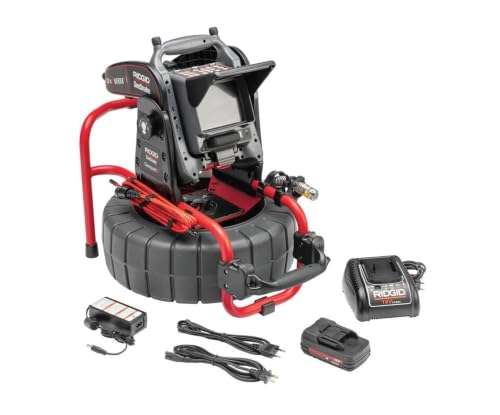
SeeSnake Compact2 Kit
100 ft · 1½–6 in. lines
Self-leveling sewer inspection system.
View on Amazon ↗Fit details
Catalog 65103 includes the reel, CS6x Versa monitor, battery and charger. Check the selected package: 48093 is reel-only and 65098 omits battery/charger. The 1-in. head has a 512 Hz sonde; a locator is separate.
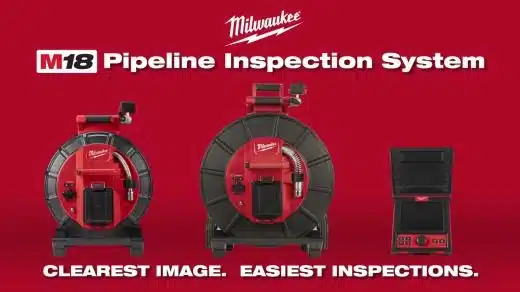
Range graphic · See kit contents in Fit details.
Milwaukee · 2973-22 kit
M18 120-ft Camera System
120 ft · 2–6 in. lines
25 mm self-leveling inspection head.
Display/tablet sold separately.
Fit details
2973-22 includes reel, 500GB control hub, two XC5.0 batteries, rapid charger and tablet mount. Display/tablet is separate. Check package contents, app/device compatibility and locating accessories.
Model specifications ↗Locating tools
Compatible sonde receiver1 option
Check the fit before you buy
Check camera and locator compatibility →RIDGID
Scout Sonde Locator
512 / 640 / 874 Hz / 33 kHz
Locate a compatible camera sonde.
View on Amazon ↗Fit details
Catalog 19238. Match the sonde frequency. A locator is separate from the camera; locating accuracy varies with depth, interference and conditions. Verify location before digging.


