
Sergeant Plumber Field Guide • Under the Sink
Sink Trap Sizes: 1¼ vs. 1½-Inch P-Traps
Check the connections before buying the bend. The right size is only part of a leak-free fit.
From Sergeant Plumber Corp. • Veteran-owned in North Texas
Published August 30, 2026 • About 6 minutes

The quick answer
1¼-inch tubular traps are common at bathroom sinks; 1½-inch tubular traps are common at kitchen sinks. But do not buy by room alone. Check the sink’s tailpiece, the existing trap, and the wall connection.
A compatible 1½-inch trap can accept a 1¼-inch tailpiece with the specified reducing washer. That does not make every trap, washer, and drainpipe interchangeable.
A drip under the sink is frustrating enough without a second trip for the right fitting. This guide helps homeowners, builders, and property managers identify common tubular sink-trap connections before shopping. It is a sizing and selection guide—not a redesign of your drain or vent system.

The stopper, supply connections and P-trap serve different purposes. Start with the accessible area that matches the symptom or repair.
- Stopper and drain openingAccessible hair can collect around the stopper.
- Supply stopsIdentify and check the shutoffs before planning a repair.
- P-trapMatch the existing material, size and connection style.
Sink trap size chart: 1¼ vs. 1½ inch
| Tailpiece → trap | Check before buying |
|---|---|
| 1¼ → 1¼ inch | Check the inlet, outlet and wall adapter. Compare trap options. |
| 1½ → 1½ inch | Match the connection style, wall adapter and alignment. Compare trap options. |
| 1¼ → 1½ inch | Check whether the inlet accepts the specified reducing washer. Check reducing-washer fit. |
Oatey’s sink-plumbing guide describes these common applications and stresses checking the wall connection. The fixture requirements and applicable local rules still matter.
Compare P-traps by your existing connection
Affiliate disclosure: As an Amazon Associate, Sergeant Plumber Corp. may earn from qualifying purchases. Sergeant Plumber Corp. may earn a commission from the paid links below at no additional cost to you. These are specification-based examples, not universal-fit promises or claims that we tested these exact retail items in your sink.

1¼-inch option: Dearborn P9701
A polypropylene tubular trap for a correctly matched 1¼-inch setup. Check the inlet, outlet, and existing wall adapter before choosing it.
Model check: P9700 is a different choked-throat version. The retailer’s family description mentions both styles; confirm P9701 and its package contents. Compare Dearborn’s variants.
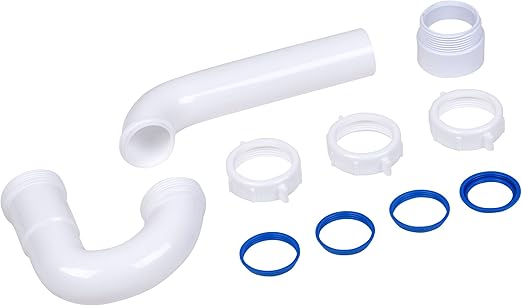
1½-inch option: Dearborn P9703WBG
A polypropylene tubular kit with a reversible J-bend, threaded PVC adapter, and reducing washer. It may suit a compatible 1½-inch assembly, including an approved connection to a smaller tailpiece.
Check the wall connection: the PVC adapter is a different component from the tubular trap. Do not assume this kit joins to every pipe material. See Dearborn’s model specifications.
Models and specifications checked August 30, 2026. Confirm the selected model, kit contents, seller, and availability before ordering. A listed adapter does not guarantee compatibility with your wall pipe. We do not show a fixed price or delivery promise.
The curved trap retains water that helps block sewer gas from the drain. A larger trap is not automatically an upgrade, and a smaller one is not a space-saving substitute for the required size. If the existing arrangement looks improvised, copying it may simply repeat the problem.
Check three places before ordering
- The tailpiece below the sink. This is the straight drain tube dropping from the sink drain or connecting assembly. Look for a size marking. When accessible, measure across a straight section of tubing—not across a nut or the enlarged end of a fitting.
- The trap and its connection style. Look for size and model markings. A thin-wall tubular slip-joint trap with nuts and washers is different from a solvent-welded drain fitting, a push-fit system, or a decorative proprietary trap. Color alone does not identify the material or joining method.
- The wall connection and alignment. Identify the trap adapter where the arm meets the drain. Note the distance and height between the tailpiece and wall connection. The replacement must fit without pulling sideways, being forced uphill, or using a string of improvised adapters.
Take one wide photo of the full under-sink arrangement and close-ups of the markings and connections. Keep the old parts until the replacement has been checked. Those details help a supplier or plumber identify what you actually need.
Connections checked? Compare the trap options
Can a 1¼-inch tailpiece fit a 1½-inch trap?
Often, yes—at a connection designed for the matching reducing washer. The smaller opening of the washer fits the 1¼-inch tubing; its outer shape seals in the compatible 1½-inch slip-joint fitting. The nut compresses that seal as the manufacturer intends.
Dearborn lists size-specific reducing washers. They are not the same as regular same-size washers, and they are not meant to seal an arbitrary tube inside a bare wall pipe. Match the washer, nut, fitting, and tubing as an assembly.
Do not stack washers, force a large tailpiece into a smaller trap, or use thread tape and putty to compensate for the wrong parts. Different joints can use different sealing arrangements—including joints without a separate washer—so follow the exact kit instructions.
Plastic, chrome, or a new washer?
Choose the repair that addresses the actual defect. A damaged seal in an otherwise sound, aligned assembly may call for the correct replacement washer. Cracked plastic, damaged threads, or badly corroded tubing may call for a complete matched assembly. Water running down from the sink drain or supply connection can make the trap look guilty when the leak starts higher up.
Plastic tubular parts are common inside cabinets. Chrome-plated metal can suit an exposed installation, but the finish does not establish fit. Check the connection design and material instructions; a polypropylene tubular trap is not a PVC glue fitting just because both are plastic. Avoid buying a flexible accordion-style substitute simply to overcome a layout that does not line up—have the configuration checked.
Know when a part swap is not enough
If you plan to open a removable trap, stop use of the sink and any connected appliance, put a bucket underneath, and protect yourself from wastewater. If drain-cleaning chemicals may be present, do not open it casually; tell a plumber what was used. Renters should follow the property’s maintenance process before disassembly.
Stop and get help with cracked wall piping, a glued assembly that needs cutting, persistent sewer odor, recurring clogs, or a layout that would require changing the drain or vent. An S-shaped arrangement or a direct drop toward the floor needs assessment, not just a different shopping-cart item. Oatey’s trap comparison explains why the venting arrangement affects the water seal.
After an appropriate repair, test every disturbed connection while water drains and recheck for slow drips. Do not leave a bucket as the permanent fix. Our leak-detector placement guide can help with early warning under sinks, but an alarm does not repair a leak.
Common P-trap sizing questions
Can I use a 1½-inch trap on a bathroom sink?
It can be appropriate when the complete arrangement meets the fixture and drainage requirements, the wall connection fits, and any smaller tailpiece uses the specified reducing washer. Do not decide from the room name alone.
Are all 1½-inch P-traps interchangeable?
No. Tubular, solvent-welded, push-fit, and proprietary assemblies can have different dimensions and seals. Check the inlet, outlet, material, adapter, and installation instructions—not just the size printed on the front of the bag.
Does a reducing washer make the drain smaller?
At the connection described here, it seals a smaller tailpiece into a compatible larger trap inlet. It does not change the size of the entire drain system or authorize reducing a required downstream drain size.
Should I put thread tape on slip-joint nuts?
A conventional washer-type slip joint seals at the washer, not by packing tape around the nut’s threads. Check the exact joint and follow its instructions. Tape is not a fix for a cracked fitting, misalignment, or an incorrect washer.
Will a bigger trap fix a slow sink?
Not necessarily. The restriction may be in the stopper, trap, or farther along the drain. Size changes do not replace diagnosis, and an incorrectly configured trap can create new problems. Our bathroom-sink clog tool guide compares reachable hair removal, sink plungers and hand-snake limits before you buy equipment.
A dry cabinet starts with the right repair.
Sergeant Plumber Corp. helps homeowners in The Colony and surrounding North Texas communities with sink leaks, drain problems, and fixture repairs. Send clear photos and tell us where the water first appears.
Ask about an under-sink leak Call (972) 595-4431
Veteran-owned • Responsible Master Plumber Bryan Messman • Texas M-43168