
UNDER THE SINK / TOOL COMPARISON
Basin Wrench vs. Faucet Installation Tool: Which Fits Under Your Sink?
A tool that reaches the faucet is not necessarily a tool that fits it. Here is how to choose without buying a drawer full of almost-right wrenches.
Sergeant Plumber Corp. · Veteran-owned · Practical plumbing, smarter buying

The short answer
Choose a basin wrench for a reachable metal mounting nut that its pivoting jaw can grip. Choose a faucet installation tool when its molded socket or insert matches the mounting nut and the supply lines fit through its opening. Neither is universal.
Why an ordinary wrench runs out of room
Under a sink, the bowl blocks your hand while the faucet shank points down into a narrow space. You might get an adjustable wrench onto the nut but have no room to swing it. A basin wrench moves the handle below that obstruction. A tubular faucet tool approaches the nut along the shank instead.
Before ordering either tool, photograph the underside of the faucet with a light. Look for a metal hex nut, a large plastic wing nut, or a mounting plate tightened by smaller screws. Those are three different jobs. A mounting plate with screws may need a screwdriver or the faucet maker’s installation tool, not a bigger basin wrench.
Where a basin wrench earns its place
The spring-loaded jaw pivots to reach a nut from below. A telescoping shaft can help on a deep sink, but extra length does not increase jaw capacity. RIDGID’s model 1017, for example, adjusts from 10 to 17 inches and has a listed 3/8 to 1-1/4 inch capacity. The larger-jaw 1019 is a different tool. Check the exact model, not just the photograph. RIDGID basin-wrench specifications.
Its teeth need a sound surface to grip. If the nut is deeply corroded, already rounded, or hidden behind hoses, buying more leverage may only make the situation worse. A tool that feels precariously balanced on one corner is not properly seated.
Where a faucet installation tool is easier
A purpose-shaped faucet tool can engage compatible plastic tabs or common nut shapes without fighting a pivoting jaw. The RIDGID EZ Change 57003 has multiple features for faucet work; those features are useful only when they match your hardware. Verify the socket pattern, insert size, and clearance around the faucet’s hoses. RIDGID EZ Change tool sheet.
This is especially important with pull-down kitchen faucets. Integrated hoses, a counterweight, and quick-connect fittings may obstruct a tool that looks perfect in an empty-sink illustration. Do not cut or twist a supply hose merely to make a tool fit.
Three checks that prevent the wrong purchase
- Match the fastener. Measure across the nut’s flats when accessible; identify plastic tabs, mounting screws, or proprietary hardware.
- Check the approach. Is there room beside the nut for a jaw, or a clear path along the shank for a tubular tool?
- Check the whole setup. A deep bowl may need more reach, but a disposal, drain, and hoses still limit the working space.
For one planned faucet replacement, buy the tool that fits that faucet. For repeated maintenance, the two styles can complement each other. Do not buy both simply because a bundle calls them essential.
When the tool is not the real problem
Shut off and verify the water supply before disconnecting faucet lines. If the shutoff will not close, the supply tube is brittle, or the faucet mounting area moves with the nut, stop. Protecting the sink and piping matters more than finishing with the tool already in your hand. Renters should get approval before removing an installed faucet.
After the faucet is secure, check its supplies and drain area under normal use. A tidy mounting nut does not prove every connection is dry. Keep the cabinet clear long enough to spot a slow drip.
Product options to compare
Affiliate disclosure: As an Amazon Associate I earn from qualifying purchases. If you buy through a link on this page, Sergeant Plumber Corp. may earn a commission at no additional cost to you.
These are specification-based options, not a ranked hands-on test of every product. Our project photos illustrate the work; they do not establish that every linked model was used on that job. Always confirm fit and current instructions.

RIDGID 1017 telescoping basin wrench
For compatible faucet mounting nuts where a pivoting jaw can reach. The listed 3/8–1-1/4 inch jaw capacity and 10–17 inch reach are separate measurements.
Before you buy: Not for every large plastic wing nut or proprietary mounting plate. Check the nut shape and hose clearance.
Paid link · Confirm the selected model and package before ordering.
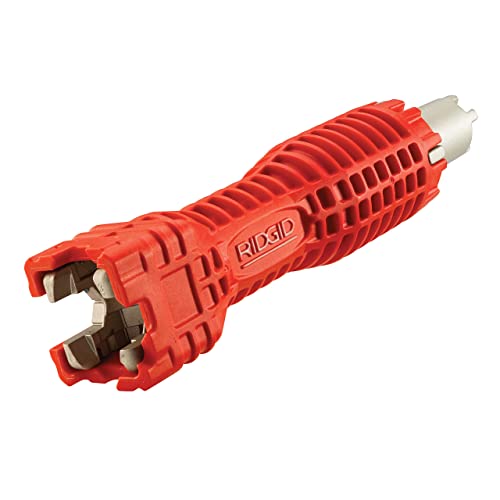
RIDGID EZ Change faucet tool — 57003
A multi-purpose option for compatible faucet hardware, with a strainer-holding feature for matching patterns.
Before you buy: Compare the molded openings and inserts with your actual fastener. Integrated faucet hoses can limit access.
Paid link · Confirm the selected model and package before ordering.
Common questions
Does every faucet need a basin wrench?
No. Some use a mounting plate, screws, or a supplied socket. Inspect the hardware and read the faucet instructions first.
Will a longer basin wrench fit a bigger nut?
Not necessarily. Shaft length and jaw capacity are separate specifications.
Can I use these tools on visible chrome?
A toothed basin wrench can mark a finish. Use the appropriate smooth-jaw tool on exposed wrench flats and protect the finish as the fixture maker directs.