
SEWER INSPECTION / COMPATIBILITY
Does Your Sewer Camera Need a Locator? Understanding 512 Hz Sondes
Before adding a locator to the cart, confirm what your camera can transmit. A receiver cannot locate a feature the camera does not have.
Sergeant Plumber Corp. · Veteran-owned · Practical plumbing, smarter buying

The short answer
A locator detects a compatible active transmitter, often called a sonde, in or near the sewer-camera head. Match the sonde frequency to the locator. A 512 Hz receiver does not make a non-transmitting camera locatable.

Access, bends and the condition of the line matter as much as headline specifications. The illustrated defects are examples, not findings from your property.
- Camera accessThe entry point and bends affect which camera fits.
- Roots and pipe jointsA view inside can help document visible defects.
- Standing waterA low section or obstruction can limit what the camera sees.
Three separate pieces of information
A camera image shows conditions inside the pipe. A footage counter estimates cable travel from its reference point. A compatible locator detects a transmitting sonde’s signal from the surface. These are useful together, but they are not interchangeable.
For example, a camera may have traveled through several bends before reaching a defect. Its cable distance cannot simply be paced out in a straight line across the yard. That is one reason a locating feature can matter on a professional inspection system.
What 512 Hz means in this purchase
The frequency describes a signal the transmitter and receiver must support. It is not a camera-resolution rating or a guarantee of locating depth. Check the camera-system manual for the actual included sonde, then check the locator’s supported sonde frequencies.
RIDGID’s NaviTrack Scout supports 512 Hz among its listed sonde frequencies. That makes it a candidate for compatible systems, not a universal receiver for every camera sold online. RIDGID NaviTrack Scout information.
Shopping with a limited budget? Our budget sewer-camera package comparison shows which selected kits list a receiver, which rely on cable markings, and what to include in the total cost.
Reel-only and camera-package details matter
A professional camera family can have multiple packages and revisions. Confirm the exact reel, head, monitor, transmitter, and required accessories before ordering. RIDGID’s Compact2 specifications, for example, identify a built-in sonde and distinguish the reel from monitor-equipped packages. RIDGID Compact2 specifications.
For another manufacturer, use that manufacturer’s documentation. Similar appearance, connector shape, or a marketplace compatibility claim is not enough to establish that two systems work together.
Compatibility checklist: five questions before you buy
- Does this exact camera package include an operating sonde?
- Which sonde frequency does it transmit, and can it be enabled with the included equipment?
- Does this locator support that frequency in sonde mode?
- Which components, batteries, chargers, and carrying cases are included?
- Where can the equipment be serviced if the transmitter or receiver fails?
Keep the answers with the model numbers. A clear written compatibility answer is more useful than a generic assurance that the products are ‘professional grade.’
Compare the locator and camera options
A depth reading is an estimate, not a digging instruction
Signal interpretation depends on the site, equipment, and operator. Nearby utilities, conductive structures, orientation, and other conditions can complicate locating. Do not treat one displayed depth as a complete excavation plan. Professional confirmation and the required utility-locating process still matter before disturbing the ground.
A locator also does not tell you whether the pipe is structurally sound. Combine locating with the inspection findings and other evidence relevant to the repair.
Who actually benefits from owning one?
Contractors performing repeated camera inspections may gain considerable value from compatible locating equipment. A property owner facing one repair may be better served by hiring an inspection that includes locating and a clear explanation of the findings.
Ask what the inspection service delivers: video, accessible footage references, marked areas where appropriate, limitations, and recommended next steps. Owning the equipment is only part of producing a useful result.
The products below should be evaluated as parts of a system. Do not buy the locator first and assume any future camera will match it.
Compare sewer-camera packages & locator options →
Product options to compare
See the pictured sonde locator →
Affiliate disclosure: As an Amazon Associate, Sergeant Plumber Corp. may earn from qualifying purchases. If you buy through a link on this page, Sergeant Plumber Corp. may earn a commission at no additional cost to you.
These are specification-based options, not a ranked hands-on test of every product. Our project photos illustrate the work; they do not establish that every linked model was used on that job. Always confirm fit and current instructions.

RIDGID NaviTrack Scout locator — 19238
A professional locator supporting compatible sonde frequencies, including 512 Hz.
Before you buy: It needs a compatible operating transmitter. Confirm frequency and system contents; displayed depth is not a complete excavation plan.
View the NaviTrack Scout on Amazon
Paid link · Confirm the selected model and package before ordering.
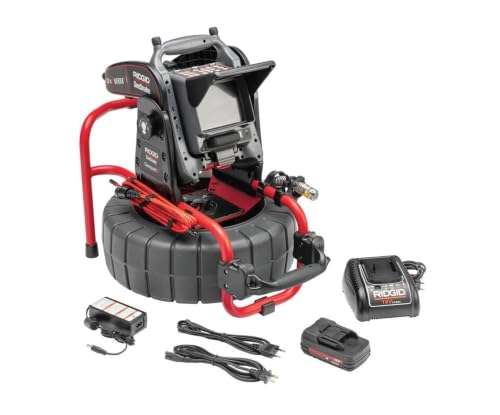
RIDGID Compact2 camera system with CS6x Versa — 65103
The verified 65103 package lists the reel, self-leveling camera, CS6x Versa monitor, battery and charger.
Before you buy: This is professional inspection equipment, not a small borescope. Reconfirm package contents, pipe coverage, service support and locator compatibility before a high-ticket purchase.
View the RIDGID 65103 system on Amazon
Paid link · Confirm the selected model and package before ordering.
Common questions
Will a 512 Hz locator find a camera with no sonde?
No. It needs a compatible active transmitter to detect.
Is 512 Hz the same as image resolution?
No. It is a locating-signal frequency, not a video-quality specification.
Can I dig using only the locator’s depth reading?
No. A depth estimate is not a complete excavation plan or a substitute for required utility locating and professional assessment.