
COPPER WORK / BUYING ADVICE
Mini Copper Tubing Cutters: What Fits in a Tight Space?
The pipe diameter gets you into the right product category. The space around the pipe decides whether the cutter can actually finish the job.
Find the right copper toolCheck size and clearance
Sergeant Plumber Corp. · Veteran-owned · Practical plumbing, smarter buying

The short answer
Choose a copper-rated cutter that covers the tube’s outside diameter and can travel around it without hitting a wall, another pipe, or a fitting. Check rotation clearance, wheel type, and replacement-wheel availability—not just the word ‘mini.’

The cut edge, mating surfaces and joining materials each have a different role. This close-up explains the work area; it does not show a particular branded tool.
- Cut edgeInspect the cut and remove the internal burr.
- Mating surfacesThe tube and fitting both need the specified preparation.
- Flux and filler choiceMatch materials and the joining method to the job.
What do you need the tool to do?
Start with the task and the measurements. A cutter and a reamer do different jobs; you may already own one of them.
Product options to compare
Affiliate disclosure: As an Amazon Associate, Sergeant Plumber Corp. may earn from qualifying purchases. If you buy through a link on this page, Sergeant Plumber Corp. may earn a commission at no additional cost to you.
These are specification-based options, not a ranked hands-on test of every product. Our project photos illustrate the work; they do not establish that every linked model was used on that job. Always confirm fit and current instructions.

CUT THE TUBERIDGID Model 101 close-quarters tubing cutter
Model 101, catalog 40617: a manual-feed cutter with a listed 1/4–1-1/8 inch tube outside-diameter range. RIDGID lists the E-3469 as its standard wheel. Check the manufacturer specifications.
Before you buy: Match the actual tube OD, copper-compatible wheel, and space for the entire tool to rotate. This is the 101, not the multilayer-only 101-ML.
View RIDGID 101 cutter on Amazon
Paid link · Confirm the selected model and package before ordering.
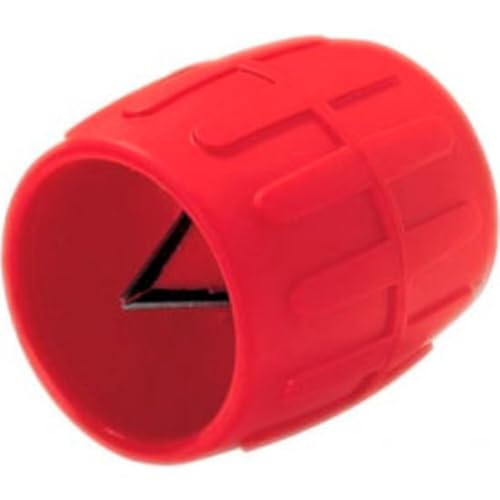
PREPARE THE CUT EDGERIDGID 127 inner/outer reamer — 34965
Model 127 prepares the inside and outside of a cut tube end. RIDGID lists a 1/4–1-1/2 inch tube outside-diameter capacity and copper as an intended material. Check the manufacturer specifications.
Before you buy: Confirm model 127 and your actual tube OD. The linked listing uses 34965; RIDGID currently lists 34965R. Verify the selected package. The 127S is a different model, and a reamer does not replace cleaning.
View RIDGID 127 reamer on Amazon
Paid link · Confirm the selected model and package before ordering.
Measure the tube, then measure the space
A close-quarters cutter wraps around the tube and advances a cutting wheel as the tool rotates. It needs enough room for its entire body—not simply enough room to slip the wheel onto the pipe. A nearby stud, valve, or second pipe can interrupt that rotation.
Sketch the available space before ordering. Measure the outside diameter of the tube and inspect the obstruction on every side. A product photo against a white background tells you very little about clearance behind a real cabinet.
Nominal copper size is not outside diameter
Cutter capacities are commonly listed by actual outside diameter. Copper water tube is often sold by nominal size, which is a different measurement. Do not assume a cutter’s stated range uses the same naming system as the pipe on your receipt. Compare measured outside diameter with the exact cutter specifications.
RIDGID’s model 101, catalog 40617, is listed for a 1/4- to 1-1/8-inch outside-diameter range. Other compact models cover different ranges; a nearly identical-looking tool is not necessarily a substitute. RIDGID close-quarters cutter specifications.
Manual feed, automatic feed, or ratcheting?
A manual-feed cutter lets you control wheel pressure through its adjustment knob. An automatic-feed design applies pressure through its mechanism. A ratcheting arrangement can help where a full hand movement is awkward, but it still needs the clearance its manufacturer specifies. None of these designs makes a buried or inaccessible section of pipe safe to cut.
For occasional accessible repairs, a basic quality cutter may be enough. For frequent tight-space work, the premium is worth considering only after you know what problem the mechanism solves. Avoid buying an expensive ratchet simply because the word ‘professional’ appears in the title.
The cutting wheel is a consumable
- Material: confirm the installed wheel is intended for the tube material. A tool family may use different wheels for copper, plastic, or other tubing.
- Condition: a chipped or worn wheel can produce a poor cut even when the body looks fine.
- Replacement: identify the correct wheel part number before it becomes an urgent jobsite purchase.
- Tracking: a cutter that spirals instead of following one line needs attention; do not keep tightening it to force the result.
Do not stop at the cut
A tubing cutter can leave an inward burr. The next purchase may be a suitable reamer or deburring tool, not another cutter. The Copper Development Association’s tube handbook treats cutting, reaming, cleaning, and joining as separate preparation steps. Match preparation to the connection system you will use. Copper Tube Handbook.
Keep chips out of the open tube and check the finished end for damage. A press, solder, flare, or other connection may have its own additional requirements; a clean-looking edge alone does not establish that the joint is ready.
When not to make the cut
Identify the line and its service before touching it. This buying comparison is not permission to cut a live water line, fuel-gas pipe, refrigerant tube, or concealed line. Water must be safely isolated, and the repair plan should be clear before a pipe is opened. If there is no safe access, opening the correct access area or calling a plumber can be more sensible than trying increasingly small tools.
Common questions
Will a mini cutter work on every copper pipe?
No. Check its outside-diameter range, wheel specification, and rotation clearance.
Do I still need to deburr after using a tubing cutter?
Yes, inspect and prepare the tube end as required by the joining system. A cutter can leave an internal burr.
Can I use the same wheel on plastic and copper?
Only if the manufacturer specifies that wheel for both materials. Verify the installed wheel, not just the tool family.