
Oatey Sta Put Ultra Plumber's Putty Review: Fixture Compatibility Checklist
Oatey Sta Put Ultra is a moldable plumber's putty intended for selected fixture flanges and bases. It can create a neat, serviceable bedding seal, but only when the fixture, drain, and surface instructions allow putty. The most important feature is compatibility, not how easily the material rolls into a rope.
Quick answer
Sta Put Ultra can fit an approved sink strainer, pop-up drain flange, faucet base, or similar nonpressurized bedding application. Verify the current label and both component manuals before use, especially on natural stone, engineered stone, porous counters, plastics, coated finishes, and assemblies supplied with gaskets. Do not use Sta Put Ultra on ABS or ABS-blended materials. It is not pipe-thread sealant, caulk for vertical gaps, or a repair for a cracked fixture.

A drain flange is a different application from a pipe-thread connection. Check compatibility with the sink material and the drain manufacturer's directions.
- Faucet mounting areaAccess and fastener shape affect tool choice.
- Supply stops and hosesIdentify the connection before loosening a part.
- Drain and P-trapDrain joints seal differently from threaded supply fittings.
Who this guide is for
This review is written for homeowners replacing a visible sink or faucet component and for buyers comparing plumber's putty with silicone. It is not a substitute for the installation manual. A fixture-specific gasket or sealant instruction should always override a general preference, and concealed leaks or damaged mounting surfaces deserve professional evaluation.
How we evaluated the fit
The recommendation is based on the role of nonhardening fixture putty, common flange designs, and the need to verify the current product and fixture specifications. Sergeant Plumber Corp. is not reporting hands-on testing of this container. Formula, packaging, size, and approved-surface statements may change, so inspect the exact item received.
Three checks that matter first
Use these checkpoints to narrow the field before comparing individual models.
Read the fixture instructions first
Some drain bodies specify putty, others call for silicone, and many use a supplied gasket. The sink or counter material may also prohibit oil-based putty. Follow the most specific current instruction rather than assuming every metal flange is bedded the same way.
Classify the sealing job
Putty is compressed beneath a broad flange or base to block water at a nonpressurized surface. It does not seal tapered pipe threads, compression ferrules, slip-joint washers, supply connectors, or adhesive joints. Those interfaces require their designed sealing parts.
Check the surface and finish
Confirm compatibility with the specific sink, countertop, faucet finish, and drain material. Porous stone, composite products, plastics, and plated finishes can have special restrictions. Test or obtain manufacturer guidance when the material cannot be positively identified.
The compatibility checklist that matters
Start with the two instructions that define the assembly: the fixture manufacturer's installation guide and the drain, faucet, or strainer manufacturer's guide. Look for an explicit callout for plumber's putty, a named sealant, or a supplied gasket. Next, identify the visible surface accurately. Stainless steel, vitreous china, enameled cast iron, solid-surface material, quartz composite, cultured marble, granite, acrylic, and fireclay are not interchangeable categories. A product marketed for broad compatibility may still conflict with a coating, warranty, or component instruction. The current Sta Put Ultra label should approve the material before the package is opened.
Then examine the sealing geometry. Putty works when a flange or base evenly compresses a continuous ring against a stable, reasonably flat surface. It is poorly suited to a large open gap, a vertical movement joint, an underside gasket, or a warped and cracked mounting area. Confirm that all required washers and nuts are present and installed in the correct order. Putty above the sink cannot compensate for a missing friction washer below it, and over-tightening a drain to chase a leak can fracture a sink or deform a thin metal basket.
How a proper bedding seal is formed
Clean away old putty and approved residue without scratching the flange or counter. Dry-fit the component so the threads engage, the body clears the cabinet, and the drain can align without side load. Condition and roll the putty only as directed, creating a uniform rope large enough to remain continuous around the flange. The goal is not to pack the entire cavity. Set the part squarely, tighten the assembly in controlled increments, and prevent the body from rotating if its instructions require a fixed orientation. Even squeeze-out around the perimeter is a useful visual cue, but it does not prove the underside is assembled correctly.
Remove excess material with a nonmarring tool and recheck the component's position. A nonhardening bedding seal can be serviceable because the flange can usually be disassembled later, but that same characteristic means putty is not appropriate where a cured adhesive bond or flexible vertical bead is required. Test the completed drain with the bowl filled and then released while the cabinet remains open and dry. Inspect the flange, drain body, tailpiece, and slip joints separately; a drip lower in the assembly may travel and appear to originate at the putty line.
When silicone, a gasket, or replacement is better
Use the supplied gasket when the manufacturer designed it as the primary seal and does not call for putty above it. Choose a fixture-approved silicone when the instructions require a cured elastomer, when the surface manufacturer prohibits putty, or when the joint is a perimeter seam rather than a compressed flange. Silicone has different preparation and cure needs; swapping it casually for putty can complicate future disassembly. Likewise, pipe joint compound and PTFE tape belong on specified tapered threads, not beneath a broad fixture rim. Each product has a distinct mechanical role.
Replace rather than reseal a flange that is bent, pitted through, cracked, or mismatched to the fixture. A drain opening with a chipped sealing land, a faucet base that rocks because the deck is damaged, or a basket that cannot align with the trap requires correction before bedding. If cabinet materials are already swollen, a ceiling below is stained, or the drain connection is inaccessible, stop the test and investigate the full water path. A plumber can distinguish a flange leak from a tailpiece, overflow, disposal, trap, or supply leak before additional finishes are damaged.
Options that fit this decision
These links lead to current Amazon listings. Verify the exact model and installation requirements before ordering.
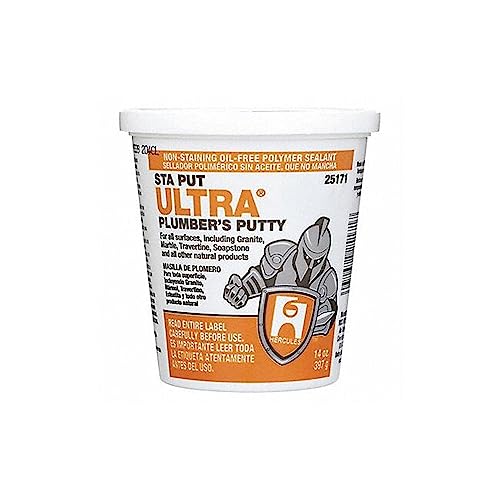
Oatey 25171 Sta Put Ultra Plumber's Putty
This putty is positioned as a fixture-bedding material in a reusable container size suitable for more than one small flange. The relevant evaluation is whether the current formula is approved for the exact sink, counter, drain, and finish. A broad compatibility claim should still be checked against the component warranty and installation guide.
Material check before buying: Oatey sells this product under its Hercules Sta Put Ultra name. Its current manufacturer guidance excludes ABS and ABS-blended materials. Check every surface the putty will touch, including the drain component and fixture, rather than relying only on the visible sink material. If a material is unknown, obtain manufacturer confirmation before use.
- Check first
- Confirm the seal is intact, the material is pliable and uncontaminated, and the current label approves the application and surface. Verify whether the fixture requires putty, silicone, or its supplied gasket, and whether any natural-stone, porous-surface, plastic, or finish limitations apply.
- Best for
- A manufacturer-approved, nonpressurized fixture flange or base that compresses a continuous bedding ring against a compatible surface.
- Skip if
- The assembly specifies a gasket or silicone, the surface is unverified, the joint is pressurized or threaded, or the flange and mounting surface are damaged or misaligned.
Frequently asked questions
Is Sta Put Ultra safe for every granite or composite sink?
Do not assume so. Check the current putty label and the exact sink and countertop instructions. Engineered and natural materials can use different resins, sealers, and finishes, so a category name alone is not enough to establish compatibility.
Does plumber's putty need time to cure before testing?
Traditional fixture putty forms a compressed, nonhardening bedding seal rather than a cured silicone bead. Follow the current product directions, then test the assembled drain as instructed. Other sealants may require a defined cure period.
Why does putty keep squeezing out after installation?
A little initial squeeze-out can occur as the flange is tightened. Continued movement may point to excessive material, an unstable component, loose mounting hardware, temperature effects, or an incorrect application. Inspect the full assembly instead of repeatedly tightening a fragile fixture.