
Great White Pipe Joint Compound Review: Where It Fits and Where It Does Not
Great White pipe joint compound is meant to help seal approved tapered pipe threads, but it is not a universal answer for every connection that leaks. The useful question is not whether the can belongs in a plumbing kit. It is whether the fitting, pipe material, carried fluid, temperature, and governing instructions all match the compound's current label.
Quick answer
Consider Great White for compatible male tapered pipe threads when the current product label and the connected equipment both permit a paste sealant. Do not use it to repair compression joints, flare fittings, gasketed unions, push-to-connect fittings, solvent-welded plastic, or damaged threads. Those connections seal by a different mechanism, so coating them can hide the real fault without creating a dependable seal.

Identify the material, service and sealing surface before applying a compound. A threaded-looking nut may rely on a washer or compression seal instead.
- Faucet mounting areaAccess and fastener shape affect tool choice.
- Supply stops and hosesIdentify the connection before loosening a part.
- Drain and P-trapDrain joints seal differently from threaded supply fittings.
Who this guide is for
This review is for homeowners and maintenance-minded readers deciding whether a brush-top thread compound fits a defined repair. It is also useful for buyers comparing paste with PTFE tape before calling a plumber. Gas piping, fire-suppression systems, medical or oxygen service, fuel equipment, and work governed by permits should be handled only by a qualified professional using products specifically approved for that application.
How we evaluated the fit
This is a specification-and-use-case review based on the product category, connection mechanics, and the need to follow the current container label and equipment instructions. Sergeant Plumber Corp. is not claiming hands-on testing of this specific can. Packaging, formulations, approvals, and seller bundles can change, so confirm the exact item before use.
Three checks that matter first
Use these checkpoints to narrow the field before comparing individual models.
Identify how the joint seals
Tapered pipe threads wedge together and often need an approved thread sealant. Compression ferrules, flare faces, O-rings, washers, and gaskets seal somewhere other than the threads. If the seal is not formed at tapered threads, Great White is generally the wrong diagnostic starting point.
Match every material and medium
Read the current label for approved pipe materials and carried media, then compare it with the valve, appliance, or fixture instructions. A compound allowed on one water connection is not automatically approved for fuel gas, chemicals, compressed air, potable water, or a plastic fitting.
Inspect before adding sealant
Cross-threading, cracked female fittings, rounded threads, corrosion, and poor alignment are mechanical problems. Clean, undamaged parts that engage correctly matter more than applying extra paste. Replace a questionable component rather than relying on a thicker coating to bridge damage.
Where a brushable pipe compound makes sense
A pipe joint compound earns its place on conventional tapered threaded connections because it fills microscopic spiral paths left between properly engaged threads and adds lubrication during assembly. The brush-top format can make a controlled film easier to apply than squeezing compound from a tube. On an approved water-supply fitting, the practical workflow is to shut off and relieve the system, separate the joint, clean away old material, inspect both thread sets, and apply only the amount and location directed by the manufacturer. Keeping sealant off the first thread and out of the pipe interior can reduce the chance of contaminating a small valve passage, although the current label remains the controlling instruction.
Paste can be preferable to tape where a component manufacturer calls for compound, where an installer wants a coating that does not unravel during positioning, or where the fitting must be aligned without shredding tape. Some tradespeople combine tape and compound, but that is not a universal best practice: it is appropriate only when the fitting manufacturer, product labels, code, and job specification permit the combination. The important buying criteria are approval for the exact pipe materials, compatibility with the medium, service temperature, pressure rating, cure or pressurization instructions, and any potable-water listing required for the installation.
Where Great White does not solve the problem
Several common connections have visible threads that merely pull sealing surfaces together. A braided supply line typically seals at its captive washer, a compression stop seals at the ferrule, and a flare fitting seals at matched conical faces. Adding compound to those straight threads does not restore a split washer, scarred flare, deformed ferrule, or misaligned tube. Slip-joint drain nuts depend on beveled washers; unions may depend on a machined seat or gasket; hose connections depend on a washer. Diagnose the sealing surface and replace the failed part instead of treating every threaded nut like tapered pipe.
Compound is also not a structural repair for a cracked fitting, weakened galvanized pipe, chemically damaged plastic, or threads that no longer hold. It should not be used as caulk around a fixture, as adhesive on a loose component, or as a patch over an active pinhole. Connections to boilers, water heaters, regulators, pumps, gas appliances, and specialty equipment may have strict manufacturer requirements that override a general plumbing habit. If the label or equipment manual is unavailable, the responsible choice is to pause rather than infer compatibility from the product's color or marketing name.
How to evaluate the exact listing before buying
Confirm that the listing is the intended Great White formulation and container size, not a similarly named sealant with different approvals. Look for a readable current label, safety data information, storage guidance, shelf-life or lot information when provided, and a brush that suits the diameter of the threads you expect to service. Compare the label with the pipe markings and the equipment manual. For plastic female fittings, overtightening is a major risk because a tapered male thread can wedge the fitting apart; sealant never increases the fitting's safe torque or makes an unapproved thread combination acceptable.
After assembly, follow the specified waiting period and testing procedure for the system. Water work should be brought back into service slowly while the connection remains visible. A dry paper towel can reveal a small water seep, but it does not replace a required pressure test. Never use an open flame to check a fuel-gas joint. If a connection leaks after correct assembly, depressurize it and investigate alignment, thread condition, part compatibility, and tightening rather than simply smearing compound around the outside. A surface coating on an assembled joint cannot reach or rebuild the actual sealing interface.
Options that fit this decision
These links lead to current Amazon listings. Verify the exact model and installation requirements before ordering.
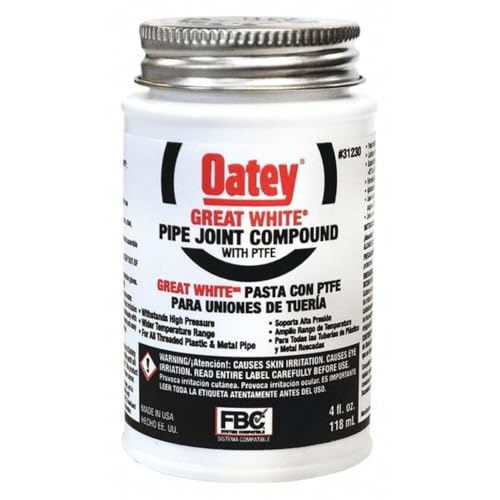
Great White Pipe Joint Compound
The brush-top format is a practical match for controlled application on approved tapered pipe threads. Its value depends on the current formulation's listed materials, media, pressure, and temperature limits, not on the broad phrase pipe joint compound. Treat the product page as a starting point and the physical label as the final reference.
- Check first
- Verify the exact formulation, current approvals, container condition, manufacturer instructions, and compatibility with both sides of the connection. Check whether the application requires a potable-water listing or a product specifically approved for gas or another regulated medium.
- Best for
- A clean, undamaged tapered threaded connection whose component instructions expressly allow a compatible paste thread sealant.
- Skip if
- The joint uses a washer, gasket, ferrule, flare, O-ring, solvent weld, push fitting, or damaged threads, or if any required approval is unclear.
Frequently asked questions
Can Great White be used instead of PTFE tape?
Sometimes, but only on a connection for which the current compound label and component instructions allow paste sealant. Tape and paste have different handling characteristics and approvals. Do not assume either product is interchangeable on every threaded material or medium.
Should compound go on compression-fitting threads?
Usually no. A compression joint seals where the ferrule meets the tube and fitting body; the nut threads create force. If it leaks, inspect tube preparation, ferrule condition, alignment, and the fitting manufacturer's instructions rather than coating the nut threads.
Can more compound stop a joint that still seeps?
Not reliably. A continuing seep can indicate insufficient engagement, cross-threading, damage, incompatible parts, misalignment, or an incorrect sealing product. Depressurize and rebuild or replace the joint according to the component instructions instead of applying compound outside the assembled fitting.