
GE Advanced Silicone 2 Review for Kitchen & Bath Plumbing Seams
GE Advanced Silicone 2 Kitchen & Bath Sealant is designed for flexible, water-exposed finish seams, not for sealing pressurized plumbing or repairing a failed drain assembly. A good result depends as much on removing old silicone, drying and cleaning the substrate, sizing the bead, and observing cure directions as it does on choosing the tube.
Quick answer
This clear kitchen-and-bath silicone can be a sensible choice for compatible perimeter joints around sinks, counters, tubs, showers, backsplashes, and similar fixtures when the exact surfaces and exposure match the current label. It should not be used inside a water line, over a leaking compression fitting, as thread sealant, or as a substitute for a gasket, drain seal, grout repair, or structural adhesive.

A kitchen or bathroom sealant is not a universal repair for supply piping or trap connections. Identify the intended surface before selecting it.
- Faucet mounting areaAccess and fastener shape affect tool choice.
- Supply stops and hosesIdentify the connection before loosening a part.
- Drain and P-trapDrain joints seal differently from threaded supply fittings.
Who this guide is for
This page is for a homeowner deciding whether a small tube of clear silicone is appropriate for a visible plumbing-adjacent seam. It also helps readers separate cosmetic water management from an active plumbing leak. If water is emerging from inside a wall, below a shower pan, around a concealed valve, or from a pressurized connection, investigate the source before recaulking the visible edge.
How we evaluated the fit
The assessment compares the listed product type with common fixture-seam requirements and manufacturer-controlled variables such as substrate compatibility, cure, movement, and water exposure. It is not a claim that Sergeant Plumber Corp. performed hands-on testing of this tube. Confirm the current package because formulation statements and allowable uses may change.
Three checks that matter first
Use these checkpoints to narrow the field before comparing individual models.
Determine whether the seam is only a finish joint
Silicone manages water at a perimeter and accommodates small movement between compatible surfaces. It does not correct a loose drain body, failed valve, cracked pan, missing flashing, or leaking supply. Trace moisture to its source before treating the visible line.
Check both adjoining surfaces
A bead may bridge porcelain to laminate, metal to tile, or acrylic to a wall panel, but the current label must approve the materials. Natural stone, some plastics, coated metals, and specialty finishes can have staining or adhesion concerns that require a fixture-specific product.
Plan for preparation and cure
New silicone rarely bonds dependably to dirty or partially cured old silicone. Allow enough time to remove residue, dry the joint, tool the bead, ventilate the room, and keep the seam out of service for the period stated on the exact package.
What this silicone is well suited to do
Kitchen-and-bath silicone is intended to form an elastic perimeter seal where splashes and routine moisture would otherwise enter a narrow gap. Typical candidates include the rear edge of a countertop backsplash, the perimeter of a compatible drop-in sink, the joint between a tub and an approved wall surface, or a trim edge specifically identified by the fixture manufacturer. Clear sealant is visually forgiving in some mixed-material seams, but it can also reveal uneven substrate color and bead thickness. White or color-matched material may produce a cleaner visual result when it is approved for the same application.
Silicone's flexibility distinguishes it from rigid fillers. A countertop, tub, or metal fixture can move slightly relative to tile or a wall panel, so a flexible bead can remain intact where grout or brittle filler may crack. That advantage only applies when the bead has adequate contact on both sides and an appropriate shape. Filling a deep void entirely with sealant wastes material and can slow cure; a compatible backer material may be needed in a wide or deep joint. The sealant and fixture instructions should define acceptable joint geometry, tooling, and exposure.
Preparation determines whether the bead has a chance
Remove the old bead mechanically without gouging the fixture, then address the thin film that remains. Soap residue, body oils, cooking grease, dust, and moisture can undermine adhesion even when the surface looks clean. Use only cleaners that the sealant and substrate manufacturers permit. Wipe approved solvent off with a clean, lint-free cloth rather than letting it evaporate on the surface, then let the joint dry completely before applying sealant. Follow GE's surface-preparation instructions for the exact substrate. Masking both sides can establish a consistent edge, but remove the tape at the correct time so it does not tear a skin from the new bead. A nozzle opening cut smaller than the intended bead gives better control than trying to wipe away a heavy overfill.
Tool the sealant once, aiming for a continuous concave profile that contacts both sides without paper-thin feathered edges. Do not use a finger wet with an unknown soap mixture unless the manufacturer permits it; contaminants can affect the surface. Provide ventilation and keep children and pets away from uncured material. Published water-ready language is not the same as full cure, and cure changes with bead size, temperature, humidity, and surface conditions. The directions on the exact tube should control when the sink, shower, or tub returns to use.
Situations that call for a different repair
A sink drain flange may use plumber's putty, a fixture-approved silicone, or a supplied gasket depending on the sink and drain manufacturers. A faucet may rely on a base gasket. A shower enclosure may require sealant only on designated exterior seams so internal drainage paths remain open. Applying silicone everywhere can trap water, block weep channels, or make future service difficult. Similarly, caulking around the exterior of a loose toilet or leaking drain does not repair the wax seal or flange. The fixture instructions should show exactly where a bead belongs and where it must not be placed.
Do not use this product to seal pipe threads, compression nuts, supply hoses, valves, pressurized tubing, or a cracked fitting. Those parts need the correct mechanical seal or replacement. Persistent darkening, soft drywall, swollen cabinetry, loose tile, or odor suggests moisture beyond a surface seam and warrants investigation. If the joint is natural stone, an acrylic fixture with limited solvent tolerance, an aquarium, a food-contact surface, or another specialty application, choose a product expressly approved for it instead of extrapolating from the kitchen-and-bath label.
Options that fit this decision
These links lead to current Amazon listings. Verify the exact model and installation requirements before ordering.
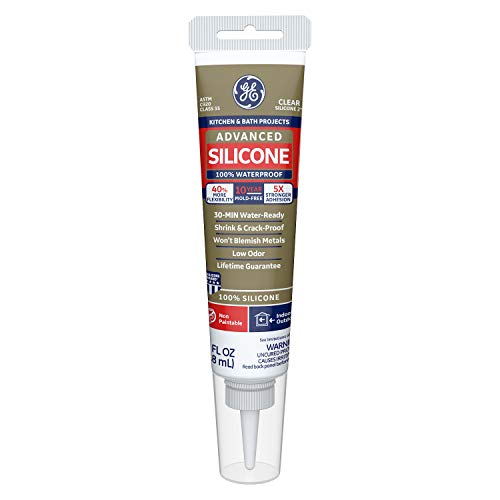
GE Advanced Silicone 2 Kitchen & Bath Sealant
The compact tube can suit a short perimeter repair and the clear finish can blend across dissimilar colors. Its usefulness rests on the exact substrate list, joint design, exposure, and cure instructions. The kitchen-and-bath designation does not convert it into a plumbing repair compound for fittings or internal water paths.
- Check first
- Confirm the tube is within its usable date, the seal is intact, the color and quantity fit the entire continuous seam, and the current label approves both adjoining surfaces. Review ventilation, cleanup, water-exposure timing, mildew-resistance language, and any natural-stone or plastic exclusions.
- Best for
- A prepared, dry, compatible nonstructural perimeter seam that needs a flexible water-resistant finish bead.
- Skip if
- The moisture comes from a pipe, drain assembly, failed gasket, pan, flashing detail, hidden cavity, or a surface the current label does not approve.
Frequently asked questions
Can Advanced Silicone 2 replace plumber's putty under a drain flange?
Only if the drain and fixture manufacturers allow silicone at that location and the product label approves the surfaces. Some assemblies specify putty, some specify silicone, and others use a gasket. Follow the component instructions rather than choosing by habit.
Can new silicone be applied over an old bead?
A dependable repair normally requires removing the old bead and residue, cleaning approved surfaces, and letting them dry. A fresh bead laid over contaminated or detached silicone may look closed while remaining poorly bonded underneath.
Why did a clear bead turn cloudy or release?
Moisture beneath the bead, incompatible cleaner, poor surface preparation, movement, an oversized joint, early water exposure, or an unsuitable substrate can contribute. Remove the failed material, correct the cause, and rebuild according to the current sealant and fixture instructions.